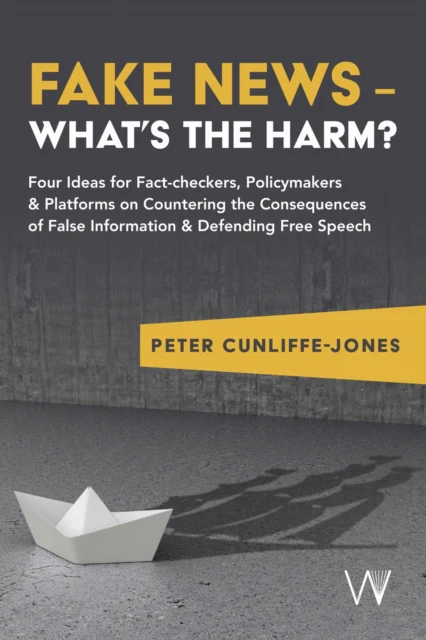
Fake News - What's the harm? : Four ideas for fact-checkers, policymakers & platforms on countering the consequences of false information & defending free speech by Peter Cunliffe-Jones
Former news reporter and founder of Africa's first fact-checking organisation Peter Cunliffe-Jones argues that since concern about `information disorder' soared in 2016, we have laboured under flawed assumptions about the nature and effects of `fake news' and misinformation. Based on a four-year review of 250 case studies, Cunliffe-Jones sets out four ideas for fact-checkers, policymakers and platforms to curb harmful consequences and protect wider freedom of speech. First, information disorder is about more than misinformation. Second, misinformation in offline settings can cause as big a problem as misinformation online. Third, misinformation that affects policymakers can be as bad as misinformation that affects the public. Fourth, he proposes a model for fact-checkers, researchers and platforms to distinguish false claims that do and do not have substantive potential to cause substantive consequences.
Binding: Paperback / softback
Binding: Paperback / softback
Former news reporter and founder of Africa's first fact-checking organisation Peter Cunliffe-Jones argues that since concern about `information disorder' soared in 2016, we have laboured under flawed assumptions about the nature and effects of `fake news' and misinformation. Based on a four-year review of 250 case studies, Cunliffe-Jones sets out four ideas for fact-checkers, policymakers and platforms to curb harmful consequences and protect wider freedom of speech. First, information disorder is about more than misinformation. Second, misinformation in offline settings can cause as big a problem as misinformation online. Third, misinformation that affects policymakers can be as bad as misinformation that affects the public. Fourth, he proposes a model for fact-checkers, researchers and platforms to distinguish false claims that do and do not have substantive potential to cause substantive consequences.
Binding: Paperback / softback
Binding: Paperback / softback
$10.95
Original: $31.28
-65%Fake News - What's the harm? : Four ideas for fact-checkers, policymakers & platforms on countering the consequences of false information & defending free speech by Peter Cunliffe-Jones—
$31.28
$10.95Description
Former news reporter and founder of Africa's first fact-checking organisation Peter Cunliffe-Jones argues that since concern about `information disorder' soared in 2016, we have laboured under flawed assumptions about the nature and effects of `fake news' and misinformation. Based on a four-year review of 250 case studies, Cunliffe-Jones sets out four ideas for fact-checkers, policymakers and platforms to curb harmful consequences and protect wider freedom of speech. First, information disorder is about more than misinformation. Second, misinformation in offline settings can cause as big a problem as misinformation online. Third, misinformation that affects policymakers can be as bad as misinformation that affects the public. Fourth, he proposes a model for fact-checkers, researchers and platforms to distinguish false claims that do and do not have substantive potential to cause substantive consequences.
Binding: Paperback / softback
Binding: Paperback / softback